
Colorants 101
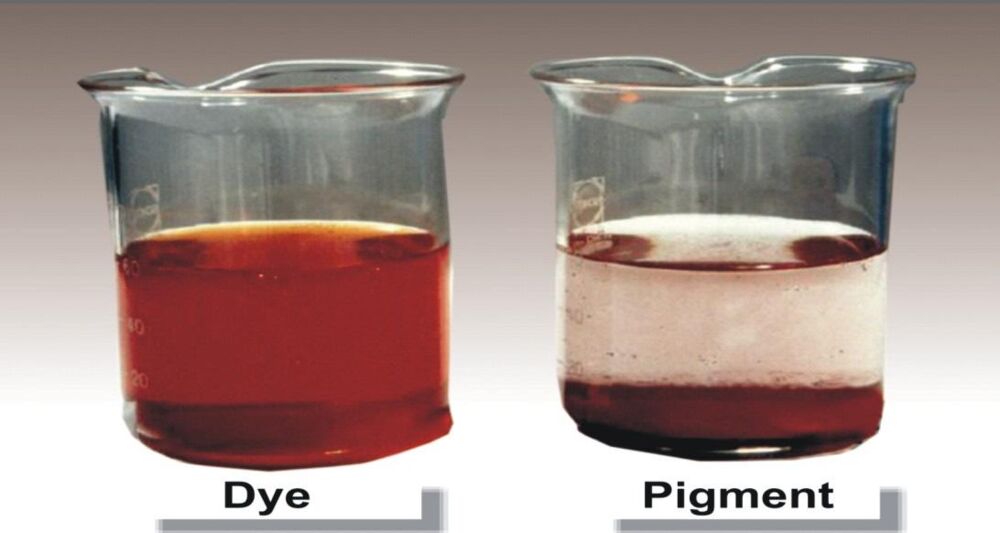
Colour additives — colorants — come in two families: pigments and dyes.
- Dyes dissolve completely in whatever they're applied to.
- Pigments do not dissolve. Instead, they're dispersed through the medium (a resin, ink vehicle, or plastic) while each particle keeps its own crystal or particle structure.
That one difference — dissolving vs. dispersing — is why a dye colours a solution evenly and transparently, while a pigment sits as tiny solid particles that scatter and reflect light, giving paints, inks, and plastics their opacity and depth of colour.
From Cave Walls to the Lab
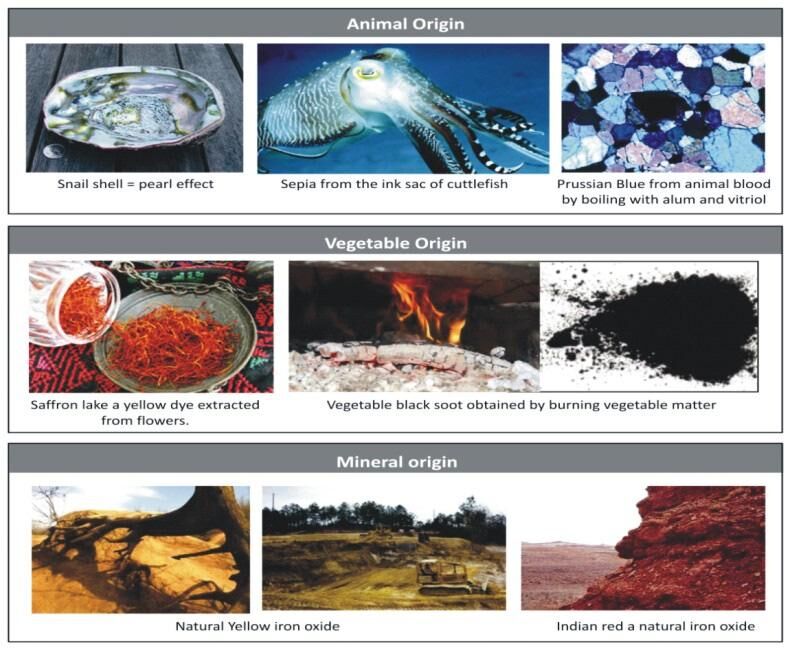
Humans have been colouring their surroundings since prehistory — the earliest evidence of pigment use survives in cave paintings and early cloth dyeing. Long before synthetic chemistry existed, pigments were pulled straight from nature:
Animal origin
- *Sepia* — from the ink sac of the cuttlefish
- *Prussian Blue* — made by boiling animal blood with alum and vitriol
Vegetable origin
- *Saffron lake* — a yellow dye extracted from flowers
- *Vegetable black soot* — from burning vegetable matter
Mineral origin
- Natural iron oxides (yellow and red earths)
These natural sources shared the same drawbacks: they were tinctorially weak (low colouring power), dirty in hue, fugitive (they faded quickly), and intrinsically hard in texture. Solving those problems is exactly what pushed pigment-making toward synthetic manufacture and refining — giving us pigments with far better strength, uniformity, cleaner tones, and softer textures.
Two Families, Two Chemistries
Pigments split first into two broad chemistry families — Inorganic and Organic — and each of those splits further:
Inorganic
- *Pure:* Lead Chrome, Iron Oxide, Cadmium, Chromocyanine, Chrome Oxide Green, Pearl
- *Extenders:* Calcium Carbonate, Barium Sulphate, Talc, Zinc Oxide, Dolomite, Silica
Organic
- *Pure:* Azo (Mono, Dis), Polycyclic (Phthalocyanines, High Performance)
- *Toners/Lakes:* 2B Reds, Rubine Toners, Violet Toner, Blue Toner, Pink Toner
This split matters because inorganic and organic pigments behave very differently in a formulation — covered next.
Choosing the Right Chemistry
|
Property |
Organic Pigments |
Inorganic Pigments |
|
Particle size |
Smaller |
Larger |
|
Specific gravity |
Low |
High |
|
Oil absorption |
High |
Low |
|
Opacity |
Transparent |
Opaque |
|
Hue |
Bright and clean |
Dull to intense |
|
Tinting strength |
High |
Low |
|
Solvent resistance |
Can bleed in solvent |
Non-bleeding |
|
Light / heat fastness |
Moderate |
Good |
Speaking the Language of Colour
Colourists describe how a shade shifts using a small, consistent vocabulary — a red can trend bluer toward violet or yellower toward orange; a green can trend bluer or yellower; a blue can trend redder or greener; and so on around the hue circle.
When shade differences are measured numerically (Δ = "delta", the difference from a standard), the L·a·b·C system is read like this:
|
Measurement |
+ value means |
− value means |
|
ΔL |
Lighter |
Darker |
|
Δa |
Redder |
Greener |
|
Δb |
Yellower |
Bluer |
|
ΔC |
Brighter |
Duller |
Mass Tone vs. Tint
Two more terms come up constantly when judging a pigment's colour:
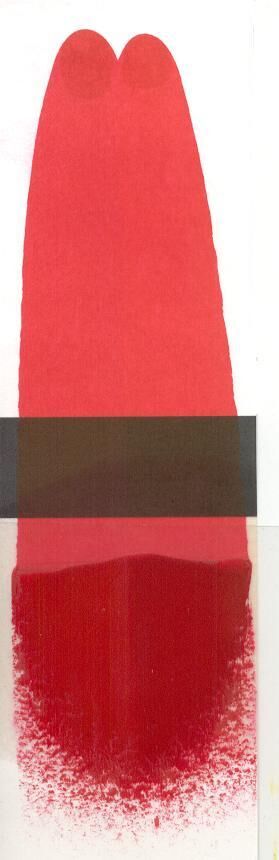
- Full shade (mass tone): the pigment dispersed in the medium on its own, at full strength.
- Tint: the pigment mixed with a white pigment and dispersed in the medium — showing how it behaves when lightened.
And when you look closely at a drawdown, a pigment can show two different undertones depending on how you view it:
- Reflected undertone — the colour you see in light reflecting off the surface of a thick (mass tone) layer.
- Transmitted undertone — the colour you see when light passes *through* a thin layer, revealing the pigment's true underlying hue.
Sudarshan's Product Ranges
Sudarshan is India's leading pigment producer and a supplier to the Plastics, Paints & Inks markets globally — with over 60 years of manufacturing experience and sales in more than 60 countries.
Its chemistries span the full spectrum used across the industry — Lead chromates, Azos, Naphthols, Isoindolinones, Benzimidazolones, DPP, Quinacridones, Azo condensations, Phthalos, Cadmium and Iron oxides — brought to market under a family of brands:
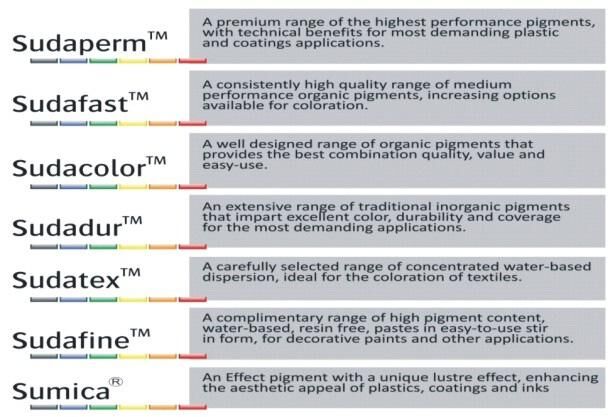
- Sudaperm™ — a premium range of the highest-performance pigments, with technical benefits for the most demanding plastic and coatings applications.
- Sudafast™ — a consistently high-quality range of medium-performance organic pigments, with a growing range of colouration options.
- Sudacolor™ — a well-designed organic pigment range balancing quality, value, and ease of use.
- Sudadur™ — an extensive range of traditional inorganic pigments, delivering excellent colour, durability and coverage for demanding applications.
- Sudatex™ — a carefully selected range of concentrated water-based dispersions, ideal for textile colouration.
- Sudafine™ — a complementary range of high-pigment-content, water-based, resin-free pastes in easy-to-use stir-in form, for decorative paints and other applications.
- Sumica® — an effect pigment with a unique lustre, enhancing the aesthetic appeal of plastics, coatings and inks.

Colour Is Everywhere
Pigments show up far beyond the paint can. The same underlying chemistry colours:
- Cosmetics — makeup and personal care products
- Paints & coatings — architectural and industrial paint
- Plastics — toys, sports balls, consumer goods
- Automotive — car and motorcycle finishes
- Textiles & yarns — dyed threads and fabrics
- Festive & decor items — candles, balloons, and more
Wherever consistent, durable colour matters, there's very likely a pigment behind it.